Read Our White Paper
Date
01.19.26
Author
Max Pfieffer, CTO
Type
Insights

The Evolving Energy Scale of AI Compute
At its core, a computer processor takes direct-current voltage and modulates the storage of electrical charge through logic gates to process digital information in a symphonic hierarchy. Year after year, the scale of the logic shrinks. Higher density lends to increases in power scale, the core physical elements that are driving the global AI revolution.
Now, AI has oversubscribed the American power grid, and a race is on to increase energy generation and distribution capacity. While alternating current (AC) plays a pivotal role in domestic safety, rotary machines, and power transmission, modern energy systems are direct-current (DC).
Photovoltaics, lithium batteries, and computers are all DC. When these elements connect to the grid, they require a converter. For solar farms, grid tie inverters and transformers connect the panels to the grid. For electric vehicles, AC-DC converters recharge the batteries. The computers in our homes and datacenters take grid power and use power supplies to produce the low-voltage DC that the chips require. All of these conversion stages add cost, inefficiency and complexity to the energy cycle.
Building a localized system from first principles where the energy is generated and consumed in the same place, AC power doesn’t make sense; all of the components are DC. This paper explores Voxel’s novel approach to energy generation, distribution, storage and reliable consumption for the modern datacenter.
Powering a Modern Datacenter
Grid interconnect availability in the United States is bleak. As of 2026, many utility providers aren’t even taking new applications for interconnect agreements. There’s not enough power. Now, you must build energy generation with the datacenter. If you’re organized, you do the two things in the same place. Many builders are turning to natural gas. But natural gas inventories and pipeline access are shrinking. Constrained costs are driving up prices. Still, solar is the cheapest LCOE (Levelized Cost of Energy) source in the US. The challenge is that you need energy storage to deliver 24/7 power. Unlike other solutions however, battery and solar prices continue to fall.
Voxel believes solar and battery storage has crossed a threshold of cost and scale; with this pairing of energy technology moving into first-place for cheap, stable, high-power computing. As a bonus, these technologies are sustainable and immune from fluctuating prices or variable maintenance costs.
These technologies also enable building power distribution with an entirely DC system. This distribution paradigm shift eliminates power conversion stages that reduce efficiency, decrease reliability, and add cost. Without a grid connection, using AC power doesn’t make sense. Deploying a solar and battery power system using the traditional AC-grid connected components would yield a system like this;
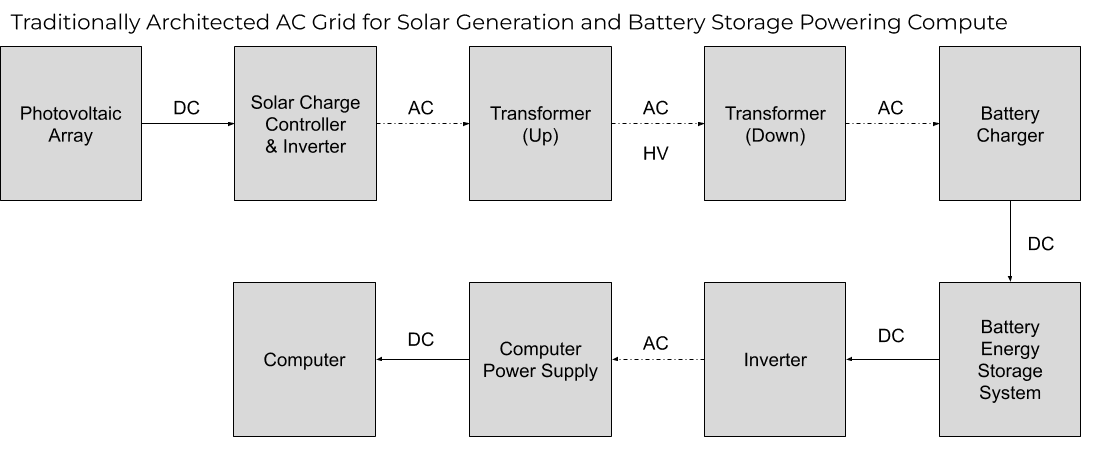
This model might have six or more power conversion stages. Each stage burns as much as 20% of the energy flow, generating heat which then also needs to be managed, increasing energy use and cost. A vicious cycle.
The Voxel Grid
Voxel’s energy generation, storage and distribution model is based on direct-current generation, storage, and consumption—the whole system is DC. In its simplest form, the energy flows from highest voltage at the PV panel source, to the lowest voltage at the load.

Fewer chained components means less cost, loss, and heat. Fewer parts means higher reliability, with fewer critical links in the chain. Conversion loss is reduced,
and may be as low as 2% per stage, with only 2 conversion stages.
Backup Generation
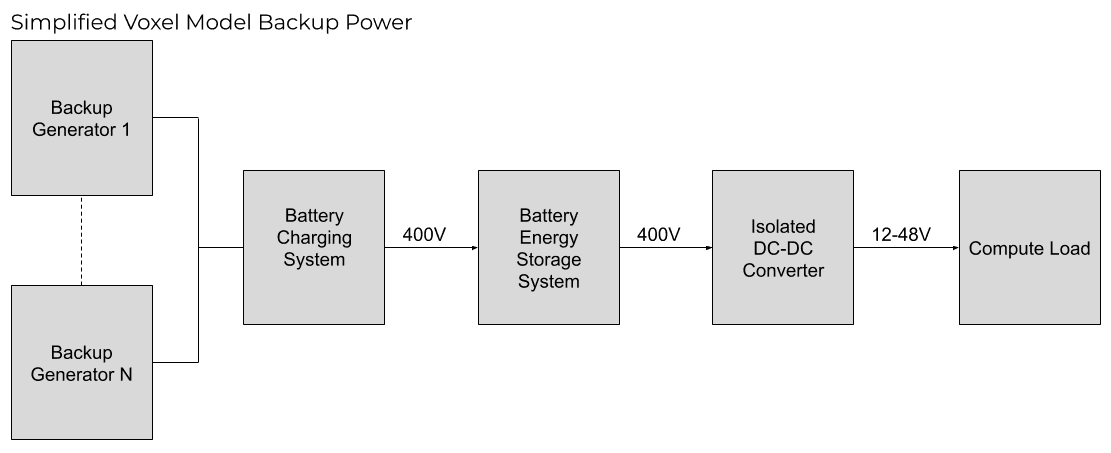
Backup power is an essential part of the modern datacenter. System efficiency pushes scale upwards, particularly with fuel based generation. So, the Voxel grid uses several centralized generation plants, working in parallel at the system level to recharge the individual BESS modules as-needed.
Surge Capacity
A traditional AC power system contains little latent energy. Load variation must be borne all the way upstream to the generation point, and fairly quickly. The demand curve below shows the surge conditions common in AI training workloads. The smaller fluctuations in power demand are often less than 10% of the system capacity, and are relatively easy to manage. The >50% capacity fluctuations, often occurring over a couple of seconds, are a serious challenge for traditional AC grids and power sources.
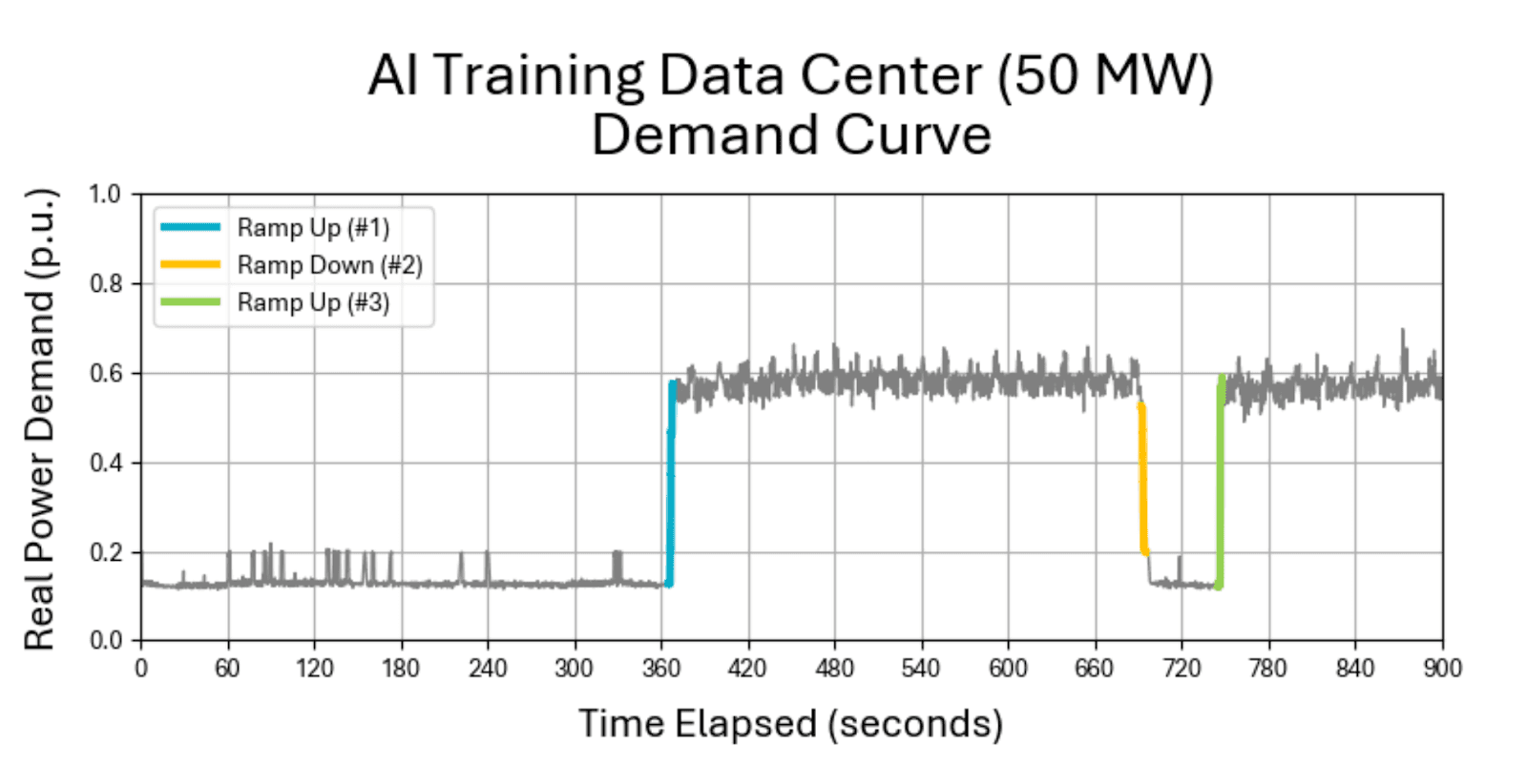
Assuming the local power supplies that run the AI nodes are adequately specified to handle rapid changes, the power grid and supporting generation may not be. Most large-scale energy generation systems are inherently not very good at rapidly varying power output. These systems have a lot of inertia. Often requiring manual coordination to avoid blackouts.
When the compute power supply is connected directly to a power source with near-instant transient response, ramps from 10-50% or even 5-95% are inherently inconsequential. Batteries sized to store energy over an 18-hour window are large enough that their discharge rating will be extremely high relative to surge demand. As an example, a single 175Ah 350V storage pack with a continuous discharge rate of 3C would be able to provide 184kW of power, versus an 18-hour discharge load spec of 3.4kW. With a ~5400% overhead on load rating, the energy storage system all but completely eliminates surge power concerns.
Conclusion
The AI revolution has overrun the traditional electrical grid, necessitating a shift toward sovereign, on-site energy systems. By moving from legacy AC infrastructure to a DC architecture, Voxel eliminates the cost and heat associated with multiple power conversion stages, reducing energy loss from as much as 30% to roughly 4%. This approach replaces monolithic failure points with a model of inherent redundancy, utilizing the stability of high-capacity battery storage to handle surge loads that would destabilize a standard grid. Ultimately, by generating and consuming DC power in a localized system, we provide the efficiency and scale required for the next generation of high-power computing.
The Evolving Energy Scale of AI Compute
At its core, a computer processor takes direct-current voltage and modulates the storage of electrical charge through logic gates to process digital information in a symphonic hierarchy. Year after year, the scale of the logic shrinks. Higher density lends to increases in power scale, the core physical elements that are driving the global AI revolution.
Now, AI has oversubscribed the American power grid, and a race is on to increase energy generation and distribution capacity. While alternating current (AC) plays a pivotal role in domestic safety, rotary machines, and power transmission, modern energy systems are direct-current (DC).
Photovoltaics, lithium batteries, and computers are all DC. When these elements connect to the grid, they require a converter. For solar farms, grid tie inverters and transformers connect the panels to the grid. For electric vehicles, AC-DC converters recharge the batteries. The computers in our homes and datacenters take grid power and use power supplies to produce the low-voltage DC that the chips require. All of these conversion stages add cost, inefficiency and complexity to the energy cycle.
Building a localized system from first principles where the energy is generated and consumed in the same place, AC power doesn’t make sense; all of the components are DC. This paper explores Voxel’s novel approach to energy generation, distribution, storage and reliable consumption for the modern datacenter.
Powering a Modern Datacenter
Grid interconnect availability in the United States is bleak. As of 2026, many utility providers aren’t even taking new applications for interconnect agreements. There’s not enough power. Now, you must build energy generation with the datacenter. If you’re organized, you do the two things in the same place. Many builders are turning to natural gas. But natural gas inventories and pipeline access are shrinking. Constrained costs are driving up prices. Still, solar is the cheapest LCOE (Levelized Cost of Energy) source in the US. The challenge is that you need energy storage to deliver 24/7 power. Unlike other solutions however, battery and solar prices continue to fall.
Voxel believes solar and battery storage has crossed a threshold of cost and scale; with this pairing of energy technology moving into first-place for cheap, stable, high-power computing. As a bonus, these technologies are sustainable and immune from fluctuating prices or variable maintenance costs.
These technologies also enable building power distribution with an entirely DC system. This distribution paradigm shift eliminates power conversion stages that reduce efficiency, decrease reliability, and add cost. Without a grid connection, using AC power doesn’t make sense. Deploying a solar and battery power system using the traditional AC-grid connected components would yield a system like this;
This model might have six or more power conversion stages. Each stage burns as much as 20% of the energy flow, generating heat which then also needs to be managed, increasing energy use and cost. A vicious cycle.
The Voxel Grid
Voxel’s energy generation, storage and distribution model is based on direct-current generation, storage, and consumption—the whole system is DC. In its simplest form, the energy flows from highest voltage at the PV panel source, to the lowest voltage at the load.
Fewer chained components means less cost, loss, and heat. Fewer parts means higher reliability, with fewer critical links in the chain. Conversion loss is reduced,
and may be as low as 2% per stage, with only 2 conversion stages.
Backup Generation
Backup power is an essential part of the modern datacenter. System efficiency pushes scale upwards, particularly with fuel based generation. So, the Voxel grid uses several centralized generation plants, working in parallel at the system level to recharge the individual BESS modules as-needed.
Surge Capacity
A traditional AC power system contains little latent energy. Load variation must be borne all the way upstream to the generation point, and fairly quickly. The demand curve below shows the surge conditions common in AI training workloads. The smaller fluctuations in power demand are often less than 10% of the system capacity, and are relatively easy to manage. The >50% capacity fluctuations, often occurring over a couple of seconds, are a serious challenge for traditional AC grids and power sources.
Assuming the local power supplies that run the AI nodes are adequately specified to handle rapid changes, the power grid and supporting generation may not be. Most large-scale energy generation systems are inherently not very good at rapidly varying power output. These systems have a lot of inertia. Often requiring manual coordination to avoid blackouts.
When the compute power supply is connected directly to a power source with near-instant transient response, ramps from 10-50% or even 5-95% are inherently inconsequential. Batteries sized to store energy over an 18-hour window are large enough that their discharge rating will be extremely high relative to surge demand. As an example, a single 175Ah 350V storage pack with a continuous discharge rate of 3C would be able to provide 184kW of power, versus an 18-hour discharge load spec of 3.4kW. With a ~5400% overhead on load rating, the energy storage system all but completely eliminates surge power concerns.
Conclusion
The AI revolution has overrun the traditional electrical grid, necessitating a shift toward sovereign, on-site energy systems. By moving from legacy AC infrastructure to a DC architecture, Voxel eliminates the cost and heat associated with multiple power conversion stages, reducing energy loss from as much as 30% to roughly 4%. This approach replaces monolithic failure points with a model of inherent redundancy, utilizing the stability of high-capacity battery storage to handle surge loads that would destabilize a standard grid. Ultimately, by generating and consuming DC power in a localized system, we provide the efficiency and scale required for the next generation of high-power computing.
Let's Get to Work