White House: Data Centers Must Provide Their Own Power
Introduction
Industry analysts shine a spotlight on AI power shortage; "Bring your own power."
Date
3.5.26
Author
VE
Type
News
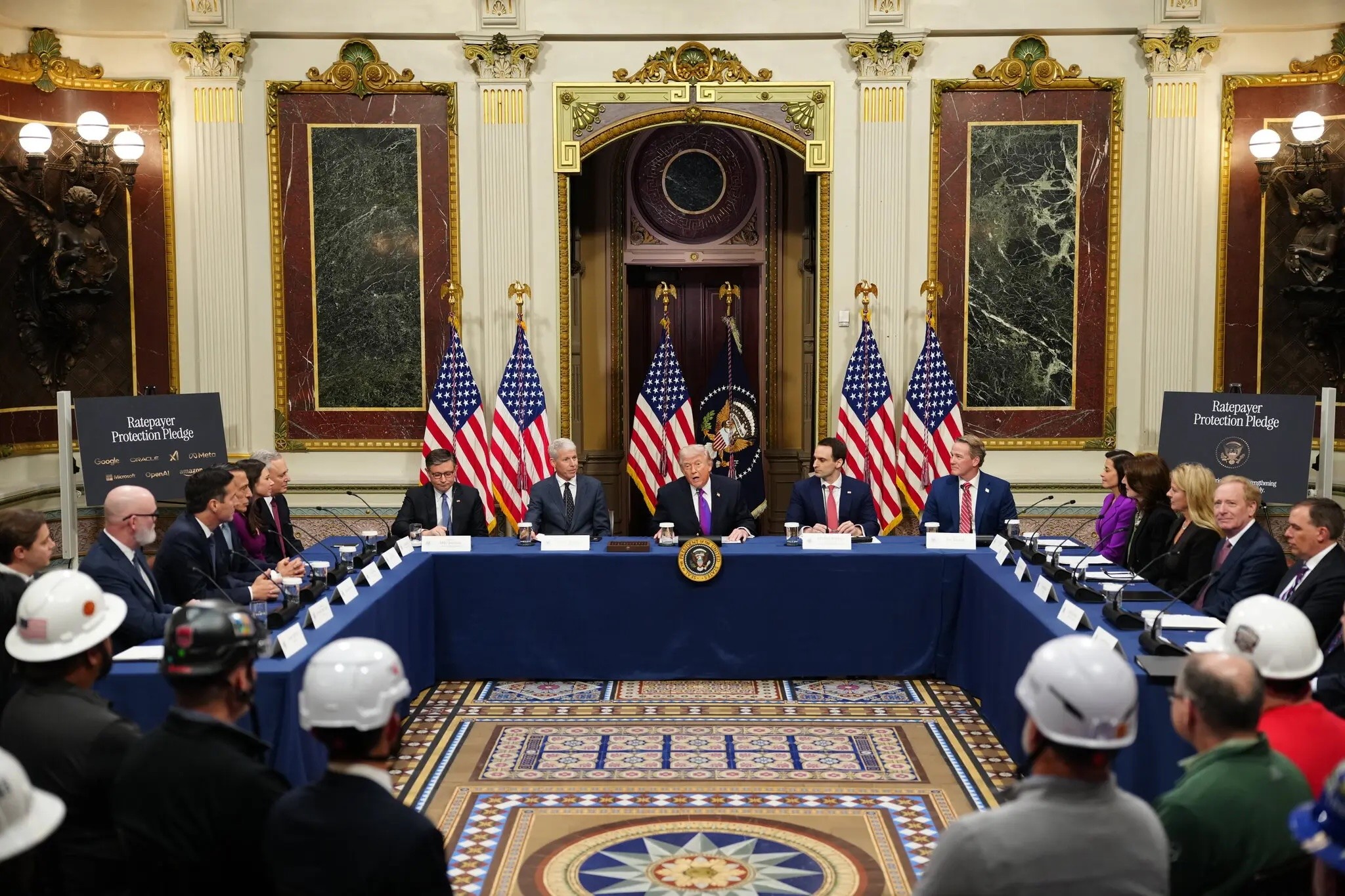
The White House just sent a clear message to the tech industry: The public grid will no longer give a free ride to data centers.
With the signing of the Ratepayer Protection Pledge on March 4, the federal government formalized a growing physical reality. If you want to build a data center, you can’t expect the local community to subsidize the infrastructure or deal with the resulting price hikes. You have to "Build, Bring, or Buy" your own power.
For most operators, this feels like a crisis. But for those looking at the math, it’s a long-overdue decoupling. To survive the AI race, data centers simply cannot cannot rely on the grid.
The Natural Gas Mirage
The "obvious" pivot for many has been natural gas. On paper, it’s firm, dispatchable power. In reality, it’s just another logistical bottleneck. Developers have rushed en masse to order NG turbine generators, causing lead times to explode to as long as seven years. The manufacturing queue for high-efficiency turbines is now as congested as the utility interconnection lines they were supposed to bypass. When you add in the volatility of fuel prices—which have spiked 16% over the last year—relying on gas is simply trading one legacy dependency for another.
The Speed of Solar + BESS
If the goal is deployment velocity, the only viable path is the modular one. While a turbine sits in a multi-year backlog, a Behind-The-Meter Solar + BESS array can be permitted, built, and commissioned in under 6 months.
The economics have also hit a tipping point. According to 2026 LCOE (Levelized Cost of Energy) data from BloombergNEF, the cost of solar-plus-storage has already dropped to approximately $57/MWh, compared to $102/MWh on average for new-build combined-cycle gas.
The Efficiency Mandate
Getting off the grid is half the battle; the other half is what you do with the electrons once you have them.
Standard data center architecture is incredibly wasteful - converting power from DC to AC and back again multiple times, losing up to 30% of the energy to heat before it ever touches a chip. Of course, this is why we’re seeing the industry move toward DC-native architecture. By keeping the power in Direct Current from the solar panel to the battery to the GPU, providers like Voxel are cutting those conversion losses down to roughly 4%.
When you eliminate the "conversion tax," your on-site power goes 25% further. It’s the difference between needing a 100-acre solar farm and a 75-acre one.
The Bottom Line
The White House pledge isn't just a regulatory hurdle; it’s a roadmap. The winners in the next decade of compute won't be the ones with the biggest utility contracts or the most generator PO's, they’ll be the ones who build around the bottlenecks.
The future of AI is off-grid, DC-native, and deployed in months, not years. Everyone else is just waiting in line.
The White House just sent a clear message to the tech industry: The public grid will no longer give a free ride to data centers.
With the signing of the Ratepayer Protection Pledge on March 4, the federal government formalized a growing physical reality. If you want to build a data center, you can’t expect the local community to subsidize the infrastructure or deal with the resulting price hikes. You have to "Build, Bring, or Buy" your own power.
For most operators, this feels like a crisis. But for those looking at the math, it’s a long-overdue decoupling. To survive the AI race, data centers simply cannot cannot rely on the grid.
The Natural Gas Mirage
The "obvious" pivot for many has been natural gas. On paper, it’s firm, dispatchable power. In reality, it’s just another logistical bottleneck. Developers have rushed en masse to order NG turbine generators, causing lead times to explode to as long as seven years. The manufacturing queue for high-efficiency turbines is now as congested as the utility interconnection lines they were supposed to bypass. When you add in the volatility of fuel prices—which have spiked 16% over the last year—relying on gas is simply trading one legacy dependency for another.
The Speed of Solar + BESS
If the goal is deployment velocity, the only viable path is the modular one. While a turbine sits in a multi-year backlog, a Behind-The-Meter Solar + BESS array can be permitted, built, and commissioned in under 6 months.
The economics have also hit a tipping point. According to 2026 LCOE (Levelized Cost of Energy) data from BloombergNEF, the cost of solar-plus-storage has already dropped to approximately $57/MWh, compared to $102/MWh on average for new-build combined-cycle gas.
The Efficiency Mandate
Getting off the grid is half the battle; the other half is what you do with the electrons once you have them.
Standard data center architecture is incredibly wasteful - converting power from DC to AC and back again multiple times, losing up to 30% of the energy to heat before it ever touches a chip. Of course, this is why we’re seeing the industry move toward DC-native architecture. By keeping the power in Direct Current from the solar panel to the battery to the GPU, providers like Voxel are cutting those conversion losses down to roughly 4%.
When you eliminate the "conversion tax," your on-site power goes 25% further. It’s the difference between needing a 100-acre solar farm and a 75-acre one.
The Bottom Line
The White House pledge isn't just a regulatory hurdle; it’s a roadmap. The winners in the next decade of compute won't be the ones with the biggest utility contracts or the most generator PO's, they’ll be the ones who build around the bottlenecks.
The future of AI is off-grid, DC-native, and deployed in months, not years. Everyone else is just waiting in line.
Let's Get to Work